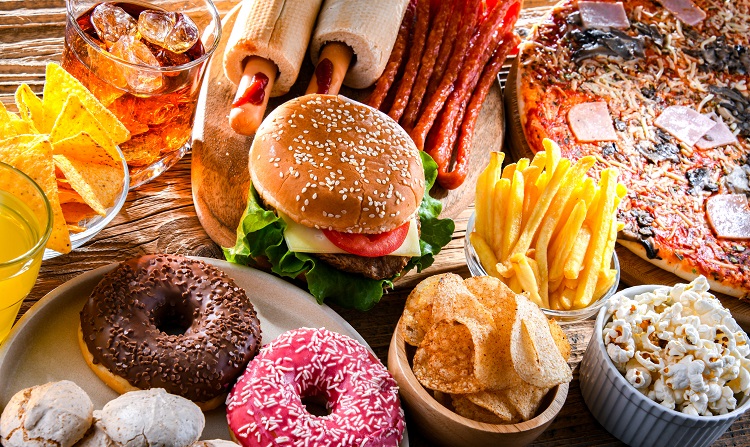
This week, the Scientific Advisory Committee on Diet (SACN) revealed its impartial report on ultra-processed meals.
In serving to advise the UK Authorities on vitamin and associated well being issues, the SACN sought to evaluation the obtainable proof on associations between processed meals consumption and well being outcomes.
Most systematic evaluations analysed reported that elevated consumption of processed meals – and particularly ultra-processed meals (UPF) – was related to an elevated danger of antagonistic well being outcomes.
However on the similar time, the impartial scientific specialists pointed to ‘uncertainties’ surrounding the standard of proof obtainable.
What are the uncertainties?
The evaluation comes as UPF finds itself the main target of extra nutrition-based research. In recent times UPF consumption has been linked to a better danger of growing most cancers and a better mortality price.
Within the SACN’s evaluation, scientists assessed systematic evaluations linking UPF with a spread of antagonistic well being outcomes, starting from chubby and weight problems to power non-communicable illnesses, despair, maternal and little one well being outcomes, and mortality danger.
Though such hyperlinks have been largely recognized, SACN members careworn ‘vital’ limitations, together with that the obtainable proof is ‘nearly completely’ observational in nature.
Additionally they famous inconsistent adjustment for covariables in addition to inconsistency between systematic evaluations concerning that are they key covariables. Because of this though antagonistic well being associations have been persistently reported, it’s ‘unclear’ whether or not these associations are because of – or impartial of – the ‘unhealthy’ nutrient contents usually typical of many UPFs, similar to salt, saturated fats, or free sugars.
Different ‘uncertainties’ encompass the systematic evaluations, in line with the federal government advisory group, embody restricted obtainable info on the affect on inhabitants subgroups in addition to socially and ethnically various teams.
“Research are nearly completely observational and confounding elements or key variables similar to vitality consumption, physique mass index, smoking and socioeconomic standing is probably not adequately accounted for,” famous the scientists, who contend extra analysis on this area is required.
NOVA ‘probably appropriate’, however not excellent
Different limitations outlined by the SACN relate to the classification of UPF. Within the absence of a universally agreed definition of processed meals, a number of classification methods have been developed world wide.
The most typical definition of UPF comes from the so-called NOVA meals classification system. Developed in 2009, the NOVA system splits ranges of meals processing into 4 classifications, from uncooked and minimally processed meals; to processed culinary substances; processed meals; and ultra-processed meals.
Of all of the classification methods examined by the SACN, NOVA was discovered to be the one one which met its preliminary screening standards as being probably appropriate to be used on home-soil. Nevertheless, evaluation of the NOVA method did establish some considerations round its sensible software within the UK.
Most notably, the classification of some meals is discordant with dietary and different food-based classifications. The scientists due to this fact suggest additional evaluation and improvement of an (ultra-) processed meals classification system that may reliably be utilized to estimate consumption of processed meals within the UK.
Why course of meals? The SACN’s evaluation acknowledges that meals processing performs numerous key roles in meals manufacturing and might supply some main advantages by way of meals security and acceptability. Meals processing can: Guarantee meals that might in any other case be inedible with out processing are edible;
Guarantee meals that might be unsafe to eat are secure;
Enhance the shelf life, preservation and retention of vitamins for some meals;
Modify the nutrient composition or bioavailability;
Enhance palatability; and
Enhance comfort
Placing ‘often-outrageous’ claims into context
The SACN’s evaluation has been welcomed by vitamin scientists, a few of whom are happy to see new concentrate on ‘uncertainties’ surrounding the standard of proof obtainable linking UPF consumption to well being points.
“There have been numerous discussions concerning the well being affect of ultra-processed meals, and these discussions have sadly been dominated by hyperbole and pointless generalisations,” in line with Gunter Kuhnle, professor of vitamin and meals science on the College of Studying.
“The assertion makes it clear that processed and ultra-processed meals are a way more complicated concern than earlier studies counsel – and clearly not as harmful as usually implied.”
The professor continued: “The SACN assertion places most of the often-outrageous claims about ultra-processed meals into context.”
The SACN report concluded by suggesting that consumption of (ultra-) processed meals could also be an indicator of different unhealthy dietary patterns and life-style behaviours. UPFsare usually vitality dense, excessive in fats, salt or sugar (HFSS), excessive in processed meat, and/or low in fruit and greens and fibre.
In response to Tom Sanders, professor emeritus of vitamin and dietetics at King’s Faculty London, such a view is ‘simplistic’, because it doesn’t differentiate between meals which can be nutrient dense from people who present vitality and little else.
He additionally stresses that trendy meals processing has helped cut back micronutrient deficiencies by way of fortification. Folic acid fortification of cereals, for instance, has prevented neural tube defects.
Meals processing due to this fact performs a ‘important position’ in feeding the inhabitants, he famous. “SACN concludes that additional analysis is required to judge whether or not the common consumption of particular extremely processed meals is dangerous.”