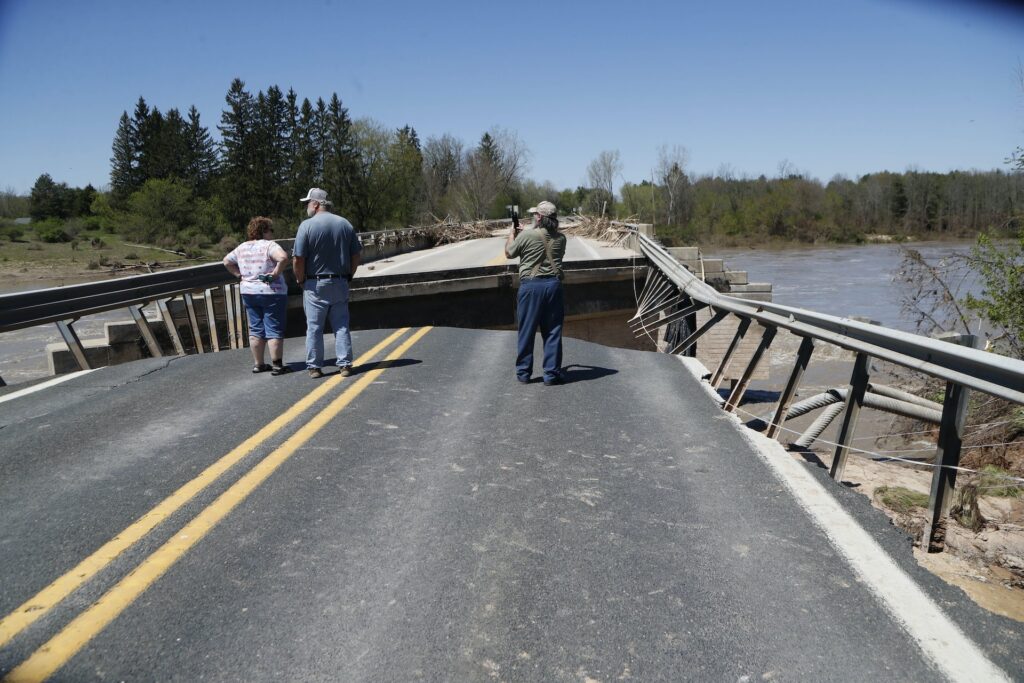
Heavy rainfall within the Northeast on June 11th of September, 2023, generated widespread flooding, notably in New York’s Hudson Valley and in Vermont. One main concern was the Wrightsville Dam, inbuilt 1935 on the Winooski River north of Vermont’s capital metropolis, Montpelier. The reservoir behind the dam rose to inside 1 foot of the dam’s most storage capability, prompting warnings that water might overtop the dam and worsen already-dangerous circumstances downstream, or injury the dam.
Hiba Baroud, affiliate professor and affiliate chair within the division of civil and environmental engineering at Vanderbilt College, explains how flooding stresses dams in a altering local weather.
How severe is the danger when flooding overtops a dam?
Dam overtopping can lead to erosion, which subsequently might result in a dam breach or failure and a sudden, uncontrolled launch of impounded water.
The chance of dam overtopping outcomes from the mixed impact of a hazardous occasion, resembling heavy rainfall, and the vulnerability of the dam. A weak dam might be outdated, poorly maintained or not have sufficient spillway capability to securely launch water from the dam.
A dam’s design can have an effect on its means to face up to overtopping and resist failure. For instance, concrete dams can usually higher face up to sure ranges of overtopping in comparison with soil embankment dams.
Overtopping is the main reason for dam failures within the U.S. It accounts for 34% of all dam failures. How lengthy water flows over a dam and the quantity of water that flows over it are necessary components in figuring out the chance {that a} dam will fail.
The implications of a dam overtopping, and presumably failing, depend upon a number of components, resembling the aim of the dam, its measurement and its location. If a dam is designed for flood safety and is surrounded by properties, companies or important infrastructure, a big uncontrolled launch of water might be catastrophic. Dams which might be small and positioned in rural areas could trigger much less injury if they’re overtopped or fail.
How outdated are most US dams?
There are greater than 91,000 dams throughout the U.S., in all 50 states, with various designs and functions. The typical dam age is 60 years, and greater than 8,000 dams are over 90 years outdated.
Each 4 years, the American Society of Civil Engineers produces a report card for the nation’s infrastructure that assigns grades based mostly on the situation of buildings like roads, bridges and dams, and the investments that they want. The newest report card estimates that 70% of U.S. dams will probably be greater than 50 years outdated by 2030.
Total, the report gave U.S. dams a “D” grade and estimated that greater than 2,300 excessive hazard potential dams – those who might trigger lack of life or severe property injury in the event that they fail, based mostly on the extent of growth round them – lacked emergency motion plans.
Are there methods to strengthen older dams in opposition to flooding with out utterly changing them?
Decommissioning or changing dams might be sophisticated and cost-prohibitive. It can also have cascading results on the encircling neighborhood, and presumably on different infrastructure. Often sustaining and upgrading older dams is usually a cost-effective option to strengthen them and make them resilient to pure hazards.
When dams not serve the needs for which they have been constructed, they could be partially breached or fully eliminated to revive the river’s pure movement.
The Affiliation of State Dam Security Officers estimates that it will value US$157.7 billion to rehabilitate all nonfederal dams within the U.S. Of this quantity, about one-fifth ($34.1 billion) is for rehabilitating excessive hazard potential dams. The 2021 Infrastructure Funding and Jobs Act contains roughly $3 billion for dam security tasks, specializing in rehabilitation, retrofitting and removing.
Is local weather change growing stress on older dams?
Local weather change is growing the frequency and depth of pure hazards like storms that threaten dams. And these shifts don’t observe historic developments. Situations that when have been thought of excessive will possible be extra widespread sooner or later.
For instance, one latest research on predicting coastal flooding discovered that in New England, a 100-year flood – that’s an occasion of a magnitude that now has a 1% likelihood of occurring in any given yr – might turn out to be an annual prevalence by the late 2100s.
The truth that the local weather is altering additionally implies that excessive occasions have gotten extra excessive. In 2015, a 1,000-year rainfall occasion in South Carolina resulted in breaches of 47 dams.
Designing new dams and upgrading present infrastructure will should be based mostly on up to date design procedures that have in mind future local weather projections, not simply historic hazardous occasions. Whereas older dams aren’t essentially unsafe, they have been constructed following outdated design requirements and development procedures and for various environmental circumstances. That influences the chance and penalties of their failure throughout disasters.
Do you see this occasion in Vermont as a warning for different communities?
The disasters which have hit the U.S. in recent times ought to spur authorities businesses and communities to arrange and plan for disasters by means of proactive steps resembling growing emergency motion plans.
Whereas the variety of excessive hazard potential dams within the U.S. has greater than doubled within the final 20 years as growth has moved farther into rural areas, the proportion of those dams with an emergency motion plan has additionally elevated. It’s now at 76%, which is far increased than only a few years in the past.
Weak dams and the danger of dam failure cascade by means of our financial system and have an effect on many sectors. Dams serve many functions: They supply water for ingesting and irrigation, generate power and shield communities from flooding. They’re additionally half of a big navigation community that transports greater than 500 million tons of commodities throughout the U.S. annually.
As my colleagues and I’ve proven, it’s necessary to know the direct and oblique prices when important infrastructure programs like dams fail. This data is essential for growing methods that may assist the U.S. put together for future disasters.